Yes it has. Crazy.
So I’ve got a sh*t tonne of catching up to do on 12 years of life shizzle, travel & music escapades, and my sight loss journey.
However, before I work out how and what to share from over a decades worth of experiences, here is something I have recently shared on Facebook and to sight loss groups on there. I find it fascinating, which is a personal blessing as once I came out of the initial ten year denial phase after I was diagnosed at the age of 23, I’ve since never really been “afraid” of my degenerative condition, more intrigued by it…
Maybe that’s how I deal with not being in control of its development.
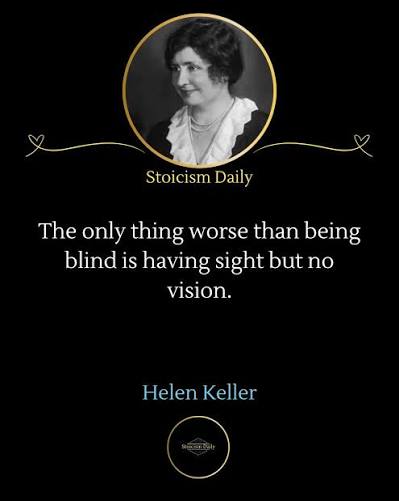
Image description:
Quotation graphic. Black and white portrait photo of Helen Keller in a circle border with “Stoicism Daily” written underneath. Below that in larger text is the quote “The only thing worse than being blind is having sight but no vision.”
This post won’t be for everyone, it’s quite specific, very nerdy and rather long. But for anyone who may be interested in general brain & sensory shiz, and/or if you have been diagnosed with any of these three conditions, this starter info could help.
Personally I have just read about Brain-Based Blindness (never heard it before) and VSS was only officially recognised as an actual condition by the worldwide medical profession last year (which I’ve always known I have, but could never explain what it was). And RP is what I’ve known about for half my life.
Be it down to medical developments, AI internet search being more detailed, or my mind being inquisitive again… Put them all together and I’ve had an epiphany (once again this past year), as a lot more things are starting to make sense.
Check this out…
(though no offence taken if you don’t continue to read, probably super boring!) 🤦🏻♀️
Retinitis pigmentosa (RP), visual snow syndrome (VSS), and brain-based blindness(such as Cortical Visual Impairment or Cerebral Visual Impairment - CVI) represent a fascinating spectrum of vision disorders.
They highlight how vision can break down at different stages of the visual pathway: the eye hardware (the retina), the visual transmission process (neurological filtering), or the processing center (the brain's visual cortex)
While historically viewed as separate entities, modern neuro-ophthalmology recognizes deep clinical overlaps and diagnostic challenges connecting these three phenomena.
————————
The Three Pillars of Visual Dysfunction:
1. Retinitis Pigmentosa (RP)
Primary Mechanism:
Ocular (Eye Hardware). Progressive genetic degeneration of photoreceptors (rods and cones) in the retina.
Core Symptoms: Night blindness, tunnel vision, loss of peripheral vision, and photopsia (flashing lights).
Diagnostic Findings:
Abnormal - Visible retinal changes, reduced visual field, and diminished electrical activity on an Electroretinogram (ERG).
2. Visual Snow Syndrome (VSS)
Primary Mechanism:
Neurological (Filter System). Hyper-excitability in the brain's visual processing centers (e.g., lingual gyrus) causing a failure to filter out "background noise".
Core Symptoms: Continuous TV-like static across the entire visual field, trailing afterimages (palinopsia), and extreme light sensitivity.
Diagnostic Findings:
Normal - Structurally perfect eyes and basic brain scans (MRI/CT), though functional imaging may show hyperexcitability.
This website about VSS and brain chemistry is super interesting.
www.maudsleybrc.nihr.ac.uk/news/new-brain-scan-study-discovers-possible-biological-basis-of-visual-snow-syndrome/
3. Brain-Based Blindness (CVI)
Primary Mechanism: Neurological (Processing Center). Damage or dysfunction to the visual cortex or post-chiasmal pathways, often due to stroke, trauma, or lack of oxygen.
Core Symptoms: Field cuts, inability to process complex visual scenes, cortical blindness (inability to see despite working eyes), agnosia, and only being able to focus on one sense at a time (e.g. looking away to hear someone talking).
Diagnostic Findings: Normal Eyes, Abnormal Brain. Structurally normal eye exams, but lesions or damage visible on an MRI or functional brain imaging.
————————
Key Overlaps and Interconnections
1. The Retinal Mimic: RP Causing "Secondary Visual Snow"
One of the most profound connections is that retinitis pigmentosa can directly cause visual snow symptoms.
* Research shows that roughly 22% of individuals with RP experience persistent visual static or a "pixelated" field of vision.
* When photoreceptors in the retina degenerate from RP, the brain loses its steady stream of baseline visual input. In response, the inner retina or the brain's visual cortex begins to "misfire," generating its own spontaneous electrical noise. This phenomenon is often diagnosed as secondary visual snow or persistent photopsia.
2. The Diagnostic Dilemma
Because true Visual Snow Syndrome (VSS) requires structurally normal eyes to be diagnosed, underlying retinitis pigmentosa is considered a classic "VSS mimic". In its early stages, RP can trigger night blindness, photophobia, and visual static—which perfectly mirror VSS diagnostic criteria. Because of this, specialized clinics like Moorfields Eye Hospital emphasize utilizing optical coherence tomography (OCT) and ERG testing to verify whether a patient's visual static is an ocular issue (RP) or a brain-filtering issue (VSS).
3. Brain-Based Processing and De-afferentation
Both RP and brain-based blindness share a concept called de-afferentation. When the brain is deprived of sensory input—either because the eye's retina has degraded (RP) or because the optical pathways are damaged (CVI)—the visual cortex experiences a sensory vacuum. This vacuum can cause the brain to abnormally adapt, leading to central changes in how vision is processed, sometimes manifesting as phantom visual patterns, static, or release hallucinations (such as Charles Bonnet Syndrome).
Management Strategies.
Because these conditions originate from different points in the visual pathway, their care teams often consist of specialized neuro-ophthalmologists, neurologists, and low-vision therapists.
* For Retinitis Pigmentosa: Management centers around preserving remaining sight via low-vision aids, mobility training, and targeted treatments like gene therapy for specific variants (e.g., RPE65 mutations).
* For Visual Snow Syndrome: Since there is no absolute cure, treatment focuses on symptom reduction. Patients often find relief using specialized chromatic filters (FL-41 or yellow-blue spectrum lenses), treating comorbid migraines, or utilizing specific neuro-optometric vision rehabilitation.
* For Brain-Based Blindness: Care heavily relies on neuro-rehabilitation, orientation and mobility training, and environmental modifications to optimize the brain's remaining visual pathways.
💪 Referral back to Moorfields Eye Hospital in London after 25 years now on top of my to-do list!
